Showing posts with label Reading. Show all posts
Showing posts with label Reading. Show all posts
Monday, February 24, 2020

Wednesday, February 5, 2020
Friday, August 30, 2019
Tuesday, December 4, 2018
Friday, November 30, 2018

Monday, October 29, 2018
Thursday, September 6, 2018

Tuesday, March 20, 2018

Friday, November 17, 2017
RAWYC
Students are jumping on to the RAWYC project. They are sharing all types of reading.
 |
| Kyle Reads While Eating |
 |
| Kinsie Reading in the Bathtub |
 | |
| Addison Reading a Chapter Book |
 |
| Brody Reading a Picture Book |
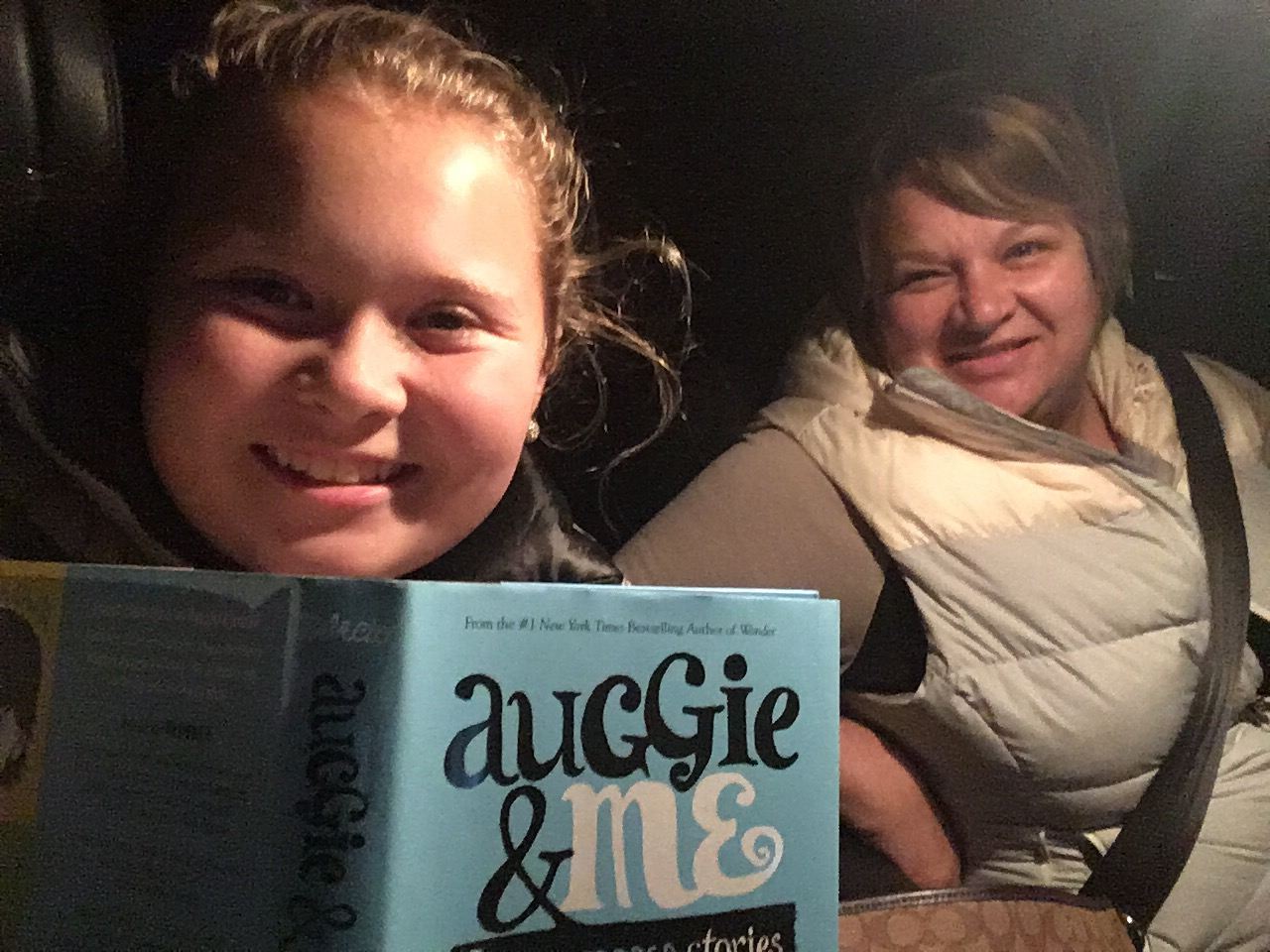 |
| Quincy Reading to Her Mom |
 |
| Alden Reading to His Cat |
 |
| Colton Reading to His Dog |
 |
| Lynsay Reading to Her Grandfather |
 |
| Kyle Reading in the Dark with a Flashlight |
 |
| Alex Reading Her Book |
 |
| Lily Reading a Chapter Book |
 |
| Cameron Reading to His Pets |
 |
| Brody Reading to His Mom |
 |
| Hayleigh Reading her Book |
 |
| Brooklyn Reading to Her Dog |
 |
| Abby Reading to Her Lap Dog |
 |
| Aubrey Reads to Bob |
 |
| Sammi Rereading a Favorite Book |
Monday, November 13, 2017
Pictures While Reading
 |
| Zoom Reads to Kinsey |
Students in Reading Workshop were challenged to post pictures from their life as they Read Any Way You Choose. Some of the pictures so far have been awesome with students reading to pets, reading to siblings, reading a TV scrollbar, reading while dribbling a basketball, and reading in the bathtub.
Here are a couple of pictures from my weekend with my grandson, Carter aka Zoom and my granddaughter, Kinsey.
 |
| Zoom and I Reading on Our IPads |
Tuesday, November 7, 2017
Reading Any Way You Choose
Pick one of the ways of reading listed below and RAWYC! Have someone take a picture or take a selfie, post it on your blog and you get 20 minutes of Read at Home credit plus you can log the minutes you read. You can do 5 of these a week, make your blog great, and get an A on your Read at Home all at the same time.
You can blog from a browser on your phone or tablet using Chrome, Firefox, or Edge. You can also post using the Edublog app with Android or Wordpress.org app using an IPhone or IPad.
You can blog from a browser on your phone or tablet using Chrome, Firefox, or Edge. You can also post using the Edublog app with Android or Wordpress.org app using an IPhone or IPad.
√
|
Reading…
|
√
|
and
|
√
|
More Reading
|
Read a picture book
|
Listen to a parent or guardian read
|
Read closed-captioning on the TV
| |||
Read a chapter book
|
Read to a parent or guardian
|
Read with a pointer or finger puppet
| |||
Read and solve math word problems
|
Read in bed, past your bedtime
| ||||
Read a story or book you wrote
|
Read a recipe aloud, step-by-step, while you help someone cook
| ||||
Read a book about something you know nothing about
|
Read with a book club you created or joined
| ||||
Read while eating
| |||||
Read a book you love AGAIN
|
Read with your friends or neighbors
|
Listen to audio books
| |||
Read a book that became a movie
|
Collect words in a jar, diary, or app
| ||||
Read a biography about a person you admire or don’t know
|
Read to the family pet or stuffed animal
|
Take turns reading a page at a time
| |||
Read at the local library, bookstore, restaurant, or coffee shop
| |||||
Read a book that will teach you a new skill, trade, or technology
|
Read with a grandparent
| ||||
Read about a state or country
|
Read with a brother or sister
|
Read in the bathtub (no water)
| |||
Read a book from your favorite author
|
Read to babies and toddlers
|
Read and sing song lyrics with the artist or choir
| |||
Read to family or friends with Skype or Facetime
| |||||
Read a comic book or joke book
|
Organize your bookshelves
| ||||
Follow a recipe from a cook book
|
Volunteer to read at a retirement home, nursing home, or hospital
|
Create a puppet show
| |||
Read a craft book
|
Read at the park or playground
| ||||
Read about caring for animals
|
Compile and share the shopping list
|
Read while riding on the bus or when riding in a plane, train, or
automobile
| |||
Read about a place you’d like to visit
|
Read a blog and respond with a positive comment
| ||||
Read about fitness and exercise
|
Make or update a memories scrapbook with captions and/or titles
|
Read at the beach or poolside
| |||
Read a book that takes place in the past or future
|
Read at the laundromat or do the laundry while a parent reads to you
| ||||
Read about your favorite sport or team
|
Keep a shared journal with
someone Take turns writing back
and forth
|
Read out loud with animated voices that go along with each character
| |||
Read a magazine or newspaper
|
Play reading games like Scrabble, Boggle, crossword puzzles
| ||||
Read a folktale, fairy tale, or myth
|
Donate books to charity or check out books from the local library
| ||||
Read a play, musical, or poetry
|
Read with a flashlight
| ||||
Read a spooky book or mystery
|
Create a video of you reading and share it on your blog
|
Rewrite the ending of a book you found boring or confusing
| |||
Read a book that received an award or honor
| |||||
Design, record, and share
commercials about books
|
Read while you wait at a restaurant, dentist, doctor’s office, or airport
| ||||
Read about holidays, traditions, or cultures from around the world
| |||||
Do a book talk or book trailer that tells all about your favorite book
|
Read cereal boxes, catalogs, flyers,
billboard signs, or street signs
| ||||
Read on an eBook or iBook
| |||||
Friday, November 3, 2017
Friday, October 13, 2017
Readers Need Strategies
Reading Workshop student, Lynsay VanHoose created this Google slideshow to point out what makes reading strategies so important.
Thursday, February 23, 2017
Pick a Strategy
The strategies in the picture below all help with understanding what you read. Reading Workshop students, your assignment is to pick one strategy, research it, create a Google slide show, and present it to the class.
The slide show needs to explain about the strategy, tell how it helps with comprehension, and how to use it. Demonstrating the strategy should be part of the presentation.
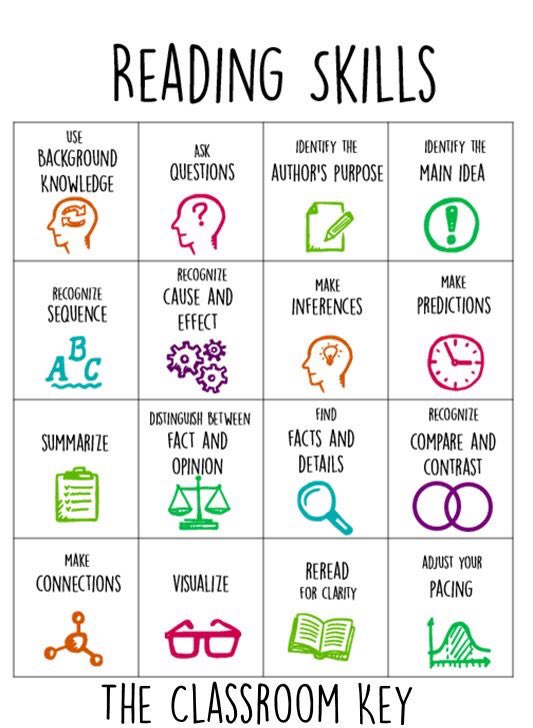
Image from http://www.theclassroomkey.com/tag/reading-strategies
Monday, October 24, 2016
Reading Assignment
Students
are required to read at home as homework. Students must read 20
minutes each night Monday – Thursday and one time over the
weekend (Friday – Sunday) for 20 minutes. Students should have a
time every night to do their reading homework. Students that do not
complete this will have serve detention to make up for missed time.
Students'
Weekly Reading Assignment rewards effort. Students choose a book that
they want to read from home, the library, or the bookmobile. The only
requirement is that they log the title, time read, and pages.
Any
time students read it counts towards their weekly minutes. They will
read each day at school during SSR--Sustained Silent Reading time
(10:55-11:10). In addition, they can read at home, on the bus, while
they are eating breakfast, once they finish a test or assignment in
another class. Any time they read it counts towards their grade.
Reading
Assignment Grading Scale
A = 180 + Minutes
B = 120 - 179 Minutes
C = 60 - 119 Minutes
F = Less than 60 minutes and/or less than 4 times a week.
A = 180 + Minutes
B = 120 - 179 Minutes
C = 60 - 119 Minutes
F = Less than 60 minutes and/or less than 4 times a week.
Extra
credit will be given for students that read more than 225 minutes in
a week.
Tuesday, September 6, 2016
Celebrate National Read a Book Day!
Today I am reading _________________ on National Read a Book Day, #ReadABookDay.
Please share the title of the book you are reading in a comment below. I am reading Among the Hidden by Margaret Peterson Haddix.

Please share the title of the book you are reading in a comment below. I am reading Among the Hidden by Margaret Peterson Haddix.
Thursday, August 18, 2016
Weekly Reading Assignment
Each week students have an assignment to read at home. Students choose a book that they want to read from home, the library, or the book room. The only requirement is that they log the date, title, time read, and pages. Students are responsible for filling out this bookmark/chart each week as they read. All minutes read outside of language arts class count towards their grade. Occasionally, students will have longer than a week when the school schedule is affected by holidays.
Students can choose to earn the grade they want. The more they read, the higher the score. A large part of their language arts grade is based on this weekly assignment.
This is the grade scale:
A = 180 + Minutes
B = 120 - 179 Minutes
C = 60 - 119 Minutes
F = 0-59 Minutes
Although students have no direct assignments associated with the Read at Home assignment and the Reading Log, many of the activities and projects in class are based on the book they are reading.
The best part of this system for monitoring reading, and increasing reading time is how students can control their grades. If they are willing to work hard, their grades will show it.
Students can choose to earn the grade they want. The more they read, the higher the score. A large part of their language arts grade is based on this weekly assignment.
This is the grade scale:
A = 180 + Minutes
B = 120 - 179 Minutes
C = 60 - 119 Minutes
F = 0-59 Minutes
Although students have no direct assignments associated with the Read at Home assignment and the Reading Log, many of the activities and projects in class are based on the book they are reading.
The best part of this system for monitoring reading, and increasing reading time is how students can control their grades. If they are willing to work hard, their grades will show it.
Friday, March 11, 2016
More Connections
We have been talking about Connections as Readers. Here are some more examples from Reading Workshop students.
Calla
Today in the book Rules by Cynthia Lord, Catherine went to Jason's birthday party where she didn't know anyone there. The only person that she knew was Jason. The way that I can relate to that part in the book is because one time I went to a party and the only person that I knew was the person hosting the party. It was pretty awkward only knowing that one person.
Rachel
The book I am reading is called Runaway by Wendelin Van Draanen. The connection I made today in my book is when Holly wants a dog. She goes to the pound to find her a dog but the pound won't let a kid have a dog unless a parent signs for it. After she left she though to herself "The pound is like a death row for dogs, only the dogs haven't done anything wrong!" That is kind of the same thing I thought when my mom, sister and I went to the pound to find a dog. The dogs look so sad when you go into a pound, I just wanted to take all of the dogs home.
Luke
I had a really serious connection with my book The Living. In The Living Shy's grandma died of a a thing called Romeros Disease. After that his cousin Miguel also got the sickness. When I was about seven or six my grandpa died of a heart attack. I was devastated just like Shy. Only a few weeks back my grandma had some of the symptoms of a heart attack and I really just panicked. But I know of all the pain Shy is having because having a dearth or near death experience hurts your heart.
Sydney Today when I was reading 'Warriors Forest Of Secrets', I read that when the war ended all of the cats were worn out and beat up. They all had to see the medicine cats to treat their wounds. They all had not to bad scars on them, but the battle hurt them. The cat that alarmed the clan was a cat called Brackenpaw, he was on a hunting mission with Fireheart (The main character) when Brackenpaw smelled the other clans! He went to tell Fireheart, and he was just in time too. He went to tell his clan that they were coming, they won the battle! Brackenpaw was named a warrior after his act of bravery... This is a connection to me because one time in the summer we were playing capture the flag! The war between the two teams were finally over. My team had won and everyone was tired and exhausted. Someone on the other team had got scratched on the elbow, so they had to get a bandaid. At the end, the person that got the flag was officially the 'king' of capture the flag.
Hailey
I am reading "The Honest Truth" by Dan Gemeinhart. While I was reading I made a connection. In this book the main character, Mark, is climbing a mountain, Mount Rainer, the tallest mountain in North America. While he is climbing the mountain his dog, Beau warns him about a crevasse. A crevasse is a really deep crack that can sometimes be on mountains, and Mount Rainer was full of them. This is a connection for me because I was walking in a field with my dog and there was a really deep hole in the ground that I didn't know about And he barked and he saved me.
JosieThe book that I am reading is Seekers Forest Of Wolves. The connection that I had with the book was a place. In the book it said that Lusa and Toklo were standing on top of the valley and they could see a path that went by a tree that had its roots sticking out of the ground that went right into the creek. I had a connection with this because at my aunt's house she has a path through the woods that leads to a tree like the one in my book. That is one of the many connections i have with my book.
Thursday, March 10, 2016
Students Are Connected
Here are some examples of connections students had as they were reading:
I
am reading a book called Zane And The Hurricane and I am on page 15 .
When I was reading page 14 they were talking about that a storm was not
going to keep going. They thought it was going to stop but it did not
stop all. That was like when hurricane Sandy hit Greater Antilles,
Eastern United States, Bermuda, Bahamas, and Eastern Canada. They
thought it was going to stop and it did not stop. It was a storm that
died down two days after.
A connection I had today was from the book "The Dog Who Danced" by Susan Wilson. The connection I got from reading this book was that it reminded me of another book I have read in the past. The other book is called "Umbrella Summer". The reason "The Dog Who Danced" reminds me of "Umbrella Summer" is because Ed and Alice's (The Dog Who Danced) daughter died and in "Umbrella Summer" the main characters brother died. The reason that made me think of this was that the characters in "The Dog Who Danced" and "Umbrella Summer" are both sad from the recent death of family members.
In
my book All Fall Down by Ally Carter it is about this girl named Grace.
Everybody thinks Grace is going crazy ever since her mom died three
years ago. People think this because Grace watched her mom die so she is
the only one who knows what really happened. Nobody believes her
though. I can make a connection with this because on Thursday night's I
help out with some little girls in dance class. There is one little girl
named Adele, she is three and her mom died last year. Ever since then
in class she'll get mad and go crazy over small things. That might be
normal for most three year olds, but that is not the way Adele used to
act.
I
just started Harry Potter and the Sorcerer's Stone. Mr. and Mrs.
Dursley have a baby named Dudley. One gray Tuesday Dudley's mom had to
wrestle little screaming Dudley in to his high chair. My connection was
when my little sister Delaney was a baby she would always scream and cry
when I tried to put her in her high chair. Her screaming would always
drive me crazy.
Erin
A connection I made while reading City of Bones is that the main character, Clary Fray is mad at her mom because her mom told Clary that they were going on vacation for the rest of the summer, and that meant that Clary to put an end to her summer actives. Clary left the house and her mom kept on calling her . Clary felt guilty because she kept ignoring her moms calls. I can connect with this because I remember a time when I was about four or five and I was mad at my mom because she was making me clean my room up and I wasn't allowed to go out until it was clean. I jumped out of the bedroom window and claimed that I was running away, but my mom caught me and made me go back inside.
A connection I made while reading City of Bones is that the main character, Clary Fray is mad at her mom because her mom told Clary that they were going on vacation for the rest of the summer, and that meant that Clary to put an end to her summer actives. Clary left the house and her mom kept on calling her . Clary felt guilty because she kept ignoring her moms calls. I can connect with this because I remember a time when I was about four or five and I was mad at my mom because she was making me clean my room up and I wasn't allowed to go out until it was clean. I jumped out of the bedroom window and claimed that I was running away, but my mom caught me and made me go back inside.
The connection that I had made to the book "You Have Seven Messages," is that the main character Luna, loves to take photos. Luna likes to take photos like of her family and friends, just like I enjoy taking. She also likes to take photos of strange things in nature, which I love to take pictures of really unique and different flowers. So in the book, "You Have Seven Messages" by Stewart Lewis, I have only made one connection, but I am sure that I will find many more!
Today as I read the book "The Body in the Woods" by April Henry- I felt a real connection with one of the main characters. There are three main characters in this book, and they all have different personality's. The main character I am most like is Alexis. I think I have a real connection with her because she is scared and paranoid of the scary things in life. In this book Alexis is the one who found the body in the woods. When she found this body she froze and stared at this dead girl. She tried to bring herself to go toured the body but it was to hard. She started walking slowly, but so slowly it was like she was walking in place. She got close enough to the body she decided to blow her whistle as loud as she could to get her friends to where she was at. She wasn't fearless. She was just so scared she almost couldn't blow her whistle. When her friends came back she just stood there staring at the dead girl's half open eyes. Even after the cops came, she wanted to believe it wasn't real, that it was just a bad dream. She honestly didn't know how to react, and I don't blame her.
Alexis is just like me because I am sacred, I am paranoid, and I can't handle situations like that. If I was her I would do almost the exact same thing. I wouldn't know how to react so I would just panic and freak out. I would freeze like Alexis did, I wouldn't be able to talk, and I definitely wouldn't be able to breath. I would pretty much have an anxiety attack. Unlike her though I would scream, as loud as I could. Then I would blow my whistle. I might act fearless (which I am), but when it comes to spiders and situations like this... I honestly don't know how to react. The only thing I'm good at is scream. Which only makes the situation scarier.
I had a lot of connections while reading the book I Am Number Four, but the biggest connection was when the main character (Johnny) was going to a Halloween Festival with his dog dressed as a superhero and his Dad. They bought raffle tickets and Johnny went to a Haunted hayride with his friends. I connected to this scene because I remember on halloween we took our dog and dressed her as a superhero too. Also because right after halloween I went to this haunted house with most of my friends. I have so many connections in this book and that's just some of them.
I am reading Code Of Honor. Kamran Smith's brother is accused of being a terrorist. Kamran just got captured and is being held prisoner of the United States Government. Kamran is being held in a cell for weeks and has talking to people about his brother, Darius. Though one night he decided to escape. He had hit a guy with a lunch tray to get out. Kamran had to run hide and sneak around until he was almost outside. Then he had to shoot a fire extinguisher to cover him while he ran past some guards. Kamran kept running and ran into the guy he hit earlier. It ended up him and someone else were coming to get him out anyway. He did all that for nothing.
Right when I read that I could relate to it. One night I was staying up pretty late on a school night to get finished with my homework. I was rushing through everything and finally got finished with all of it. It ended up we had a snow-day the next day and I kind of did all of it for nothing, just like what Kamran did. I felt good when I got finished, but when I found out I could have done it the next day I was a little mad. I bet Kamran was too.
My
connection I had today was from the book Starters by Lissa Price. There
was a part in this book were Callie went to Prime, a hospital and she
saw Michael and he had a different face because he looked bad before, at
least that is my inference. But in my old book Wonder the main
character was Aggie. He had 27 surgeries since he was born and he looked
bad.
My book is the last book of the Maximum Ride series by James Patterson and it is called Never More. I made a connection in a part in the middle of a book and it was when the main character Max got mad and kicked over a candle. When she did that it set the whole tree house on fire so she had to get out and fly away. She continued to say sorry to Dylan (the guy that made the tree house) and he continued to say it was okay. I related to that because one time I broke something glass of my grandma's and felt really bad. She said it was fine and it wasn't my fault. I still felt really bad and kept blaming my self.
My book is Belly Up and one connection I had with it was when Teddy ran into the prehistoric period exhibit with all of the animatronic dinosaurs. They were scaring him when he walked by. This reminded me of the time I went to Universal Studios in Florida to ride a ride called Jurassic Park: The Ride. We got in this boat thing and at first it was slow but then the story plot changed. One of the dinosaurs escaped! Then the boat was flying, it was so fast and when we rode by, the dinosaurs jumped and scared everyone. And then we finally reached the dinosaur that escaped, we just kept on going, right between his legs and then slid down a waterslide! That was one connection that I had with my book.
Wednesday, March 2, 2016

Subscribe to:
Posts (Atom)


 Posts
Posts


